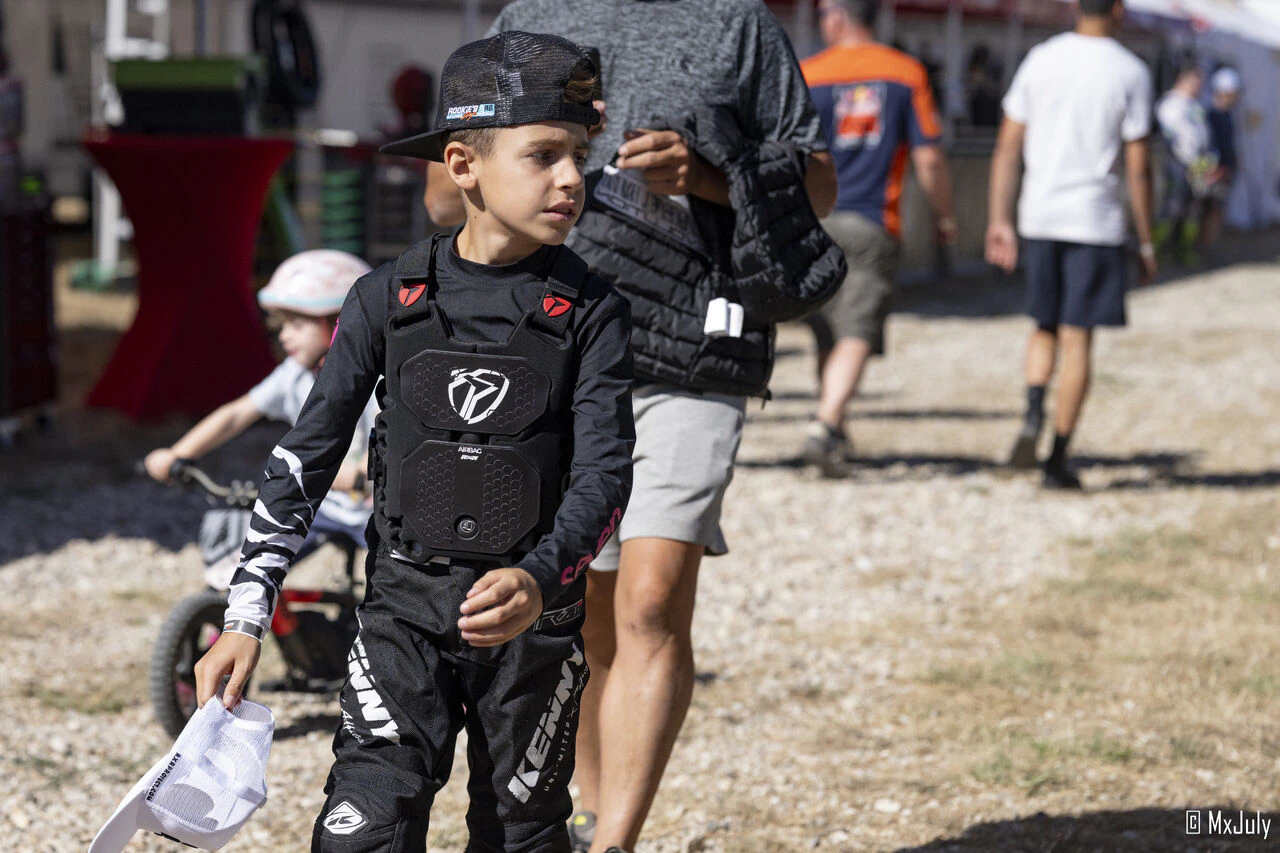
The new rules for the French Sand Championship include a new provision regarding safety:
“Although it is not mandatory, wearing a competition-approved airbag is now strongly recommended.”
At first glance, this statement seems to be aimed at protecting riders. However, upon closer reading, it raises several questions to which, at present, no one seems to have an answer.
The regulations refer to a “competition-eligible airbag.” But what does this term actually mean?
Is there an official list? A specific standard? Technical specifications? An independent certification?
Or is this wording vague enough that everyone can interpret it in their own way?
When it comes to safety, there should be no room for compromise.
The text does not make airbags mandatory, but it strongly recommends them.
Shouldn’t a recommendation of this importance be based on scientific studies, real-world trials, and solid medical data?
What specific tests have been conducted in the very unique context of sand racing?
Because sand is not a traditional speed track. The speeds, collisions, projectiles, multiple impacts, and risk of being crushed all have their own unique characteristics.
Do we now have enough hindsight to say that an airbag consistently provides a benefit in this type of race?
It’s a question worth asking.
An official recommendation inevitably influences behavior.
When a federation or organizer states that a piece of equipment is “strongly recommended,” many drivers naturally view this as a guarantee of safety.
But if, tomorrow, a pilot is seriously injured while using precisely this recommended equipment, who will bear the moral—or even legal—responsibility for this influence?
Because making a recommendation isn’t the same as imposing something. But that doesn’t mean it’s neutral.
Let’s take a simple example.
A rider crashes in the first turn. His airbag deploys.
For the remainder of the race, he then rides with equipment that, once inflated and then deflated, may no longer provide the same level of protection—a level that may even be lower than that of a Level 2-certified back or chest protector.
Has this situation been investigated? Have the drivers been clearly informed about it? Is there a protocol specifying that a deployed airbag must be replaced before resuming the race?
These are all questions that deserve clear answers before an official recommendation is issued.
No one disputes that security needs to evolve.
But it must evolve based on science, feedback, accident analyses, and independent expert assessments.
Not driven by current trends, commercial pressure, or a climate in which everyone claims to have expertise without always demonstrating it.
An official recommendation can influence the decisions of hundreds of riders. It should never be issued without meeting the highest standards.
Asking questions does not mean rejecting progress.
Quite the contrary.
It is precisely because security is such a serious matter that it requires rigor, transparency, and evidence.
Before we influence the pilots’ decisions, let’s first answer three simple questions:
Security cannot be based on beliefs or public relations tactics. It must be based on facts.